
The catalyst for carbon offtakes: delivery risk, rated by experts
Here are some key takeaways
Delivery risk — the risk that a carbon project will not issue the credit volumes it has forecast — remains one of the least-addressed sources of uncertainty in carbon markets, with material consequences for investors, buyers, developers, and insurers.
BeZero Carbon's Issuance Risk Monitor, which tracks 1,700+ carbon projects globally, shows that 35% of projects have under-delivered against their forecast by 30% or more.
Independent risk assessments — integrating carbon accounting risk (i.e. value risk) and delivery risk (i.e. volume risk) in a single pre-issuance solution — substantially reduce friction in carbon offtake agreements, and give every party in the transaction a shared, credible basis on which to transact.
One in three carbon projects under-delivers against its forecast volume by 30% or more. For anyone relying on those credits — to model returns, meet climate targets, or underwrite insurance — that statistic poses a very real business threat. This piece is about how expert, third-party assessment of delivery risk changes that.
Two types of risk
Carbon accounting risk addresses whether a credit, once issued, genuinely represents a tonne of CO₂e avoided or removed. In short, it is a measure of value risk upon issuance.
Delivery risk addresses whether a project will actually issue the number of credits it has forecast across its lifetime. In other words, it is a measure of volume risk before issuance.
While the former is thoroughly assessed by carbon ratings, the latter has received the least attention, despite its consequences being acutely felt. This partly stems from a gap in the market for scientifically robust carbon curve modeling — project finance models have been around for decades, but they typically miss the required project-level climate science, for example accurate carbon sequestration rates in Afforestation, Reforestation & Restoration (ARR) projects.
The data makes the case
BeZero Carbon's Issuance Risk Monitor tracks actual versus forecast issuance for 1,756 carbon projects globally. The median project issues credits at only 83% of its forecast level. Thirty-five per cent have under-delivered by 30% or more. Only one fifth have realised issuance within plus or minus 10% of forecast.
As one of our customers put it: 'What we would like to see, once the finance is there, is: can they deliver?'. That question, asked after capital has been committed, is already too late.
Less friction, more offtakes
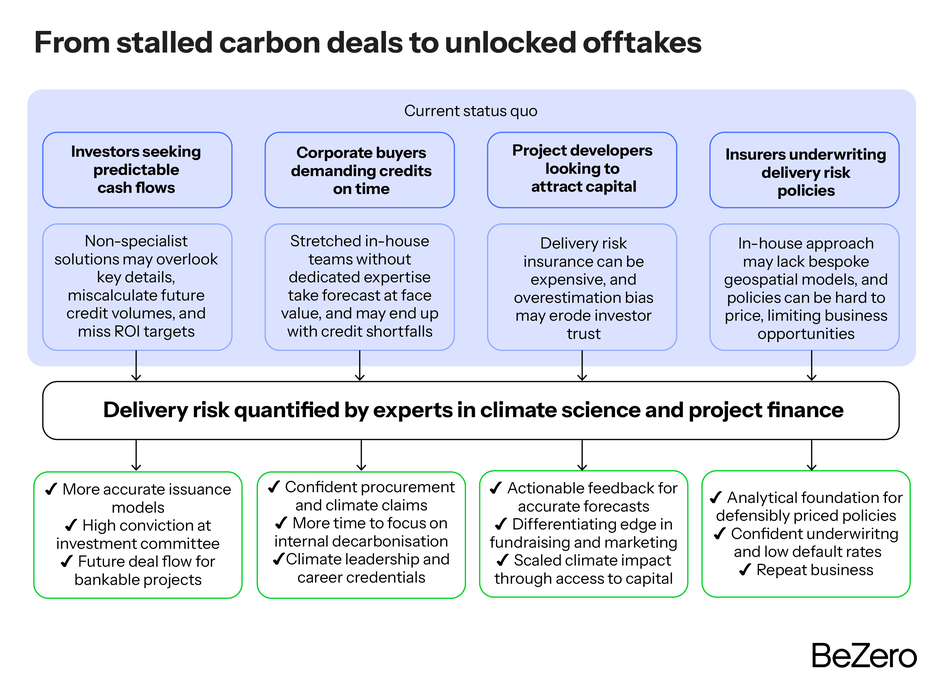
Most investors rely on external consultants or in-house teams to assess delivery risk. Most buyers rely on contractual provisions. Neither approach was designed for the analytical demands of carbon project delivery, and neither thoroughly integrates value and volume risk in a single view. The result is uncertainty that stalls deals, strains relationships, and leaves every party exposed.
When delivery risk has been independently assessed, the dynamic shifts. One buyer noted that following an independent assessment, their counterparties simply requested the report rather than conducting separate diligence. The process compressed. The transaction moved forward.
That is the commercial value of a shared, credible framework: it removes the friction that stops deals from closing, and replaces it with the confidence needed to unlock capital.
⠀
What it means for you
Investors and banks: go into investment committee with a quantified, independent view of delivery risk — and walk out with the confidence to commit capital. Over time, a track record of backing projects that deliver builds the kind of investment credentials that attract the next deal, and the one after that.
Corporate buyers: stop relying on contractual fallback and start procuring with higher certainty. Sustainability leaders who can demonstrate that their carbon strategy is delivering on quality and volume — not just intent — are building the evidence base for real climate leadership, and the career credibility that comes with it.
Project developers: turn an independent risk assessment into a commercial edge. Structured feedback across multiple risk factors improves project design before capital is committed, and a third-party rating gives buyers and investors a reason to choose your project over an unassessed alternative. At scale, that means more capital, more projects, and greater long-term climate impact.
Insurance companies: underwrite with conviction rather than caution. Expert geospatial modelling and cross-functional climate and financial expertise fill the gaps missed by in-house models, enabling more defensible policies, more competitive pricing, and higher project bankability. A track record of low-default underwriting becomes a commercial advantage in its own right.
A delivery risk assessment is available as part of our pre-issuance rating product - drop us a line to learn more.
Climate science meets project finance
BeZero Carbon’s multi-disciplinary team has delivered more than 200 pre-issuance assessments of nature- and tech-based projects since 2023 — building cross-portfolio visibility into sector-specific delivery risk that few consultant engagements can replicate. For example, our in-house climate scientists and geospatial statisticians leverage a range of public and proprietary datasets to construct carbon curves from satellite observations, field data, and literature. Our partnerships with Planet Labs and Chloris Geospatial provide access to state of the art estimates of remotely sensed carbon stocks, while the BeZero Carbon Plots Database collates field measurements and associated forest attributes from 350k sites globally.
Our methodology evaluates seven risk factors across three expanding issuance horizons, thereby covering short-, medium-, and long-term delivery risk. Each risk is assigned a current level, a potential level if mitigations are adopted, and a feasibility assessment. The output is not a pass/fail verdict. It is a structured, actionable picture of where risk sits and what can be done about it.
For an illustrative ARR project with a 40-year crediting period, BeZero identified delivery risk of 20–50% in the first five years, driven by planting delays linked to land enrolment and nursery identification. That risk moderated to 5–20% over 10 years and 0–5% over the full period — consistent with sector benchmarking showing that ARR projects typically issue around 75% of forecast credits in the first five vintages, with long-term performance broadly aligned with ex ante estimates.
Table 1. Example summary table for an illustrative BeZero Carbon delivery risk assessment.*
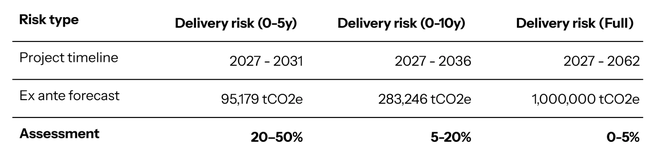
*This is a hypothetical case study. Every project is assessed individually. Final conclusions reflect the balance of risks across all risk factors, with the sole objective of producing delivery risk assessments reflective of the project’s risk profile.
Unlock your offtake agreements
Carbon markets are moving upstream. Capital is being deployed earlier, offtake agreements are being signed further from issuance, and the window to get ahead of delivery risk is narrowing.
Quantified by horizon, traceable to named risk drivers, with mitigations assessed for feasibility: that is what bankable project structuring requires, and what no other provider currently offers in a single integrated product.
If you are structuring a pre-issuance investment, negotiating an offtake agreement, or simply asking whether your current due diligence is leaving gaps, we would welcome a conversation. Get in touch.