
Can the UK government break the carbon credit market’s demand deadlock?
The UK government’s response to its Voluntary Carbon and Nature Markets consultation offers welcome clarity for credit buyers, with further guidance and demand activation measures still to come.
Buyers are encouraged to combine CCP or PACM-aligned credits with independent project-level assessments such as ratings, though how this applies under CORSIA needs clarification. Practical guidance on credit selection, use and claims will follow in Spring 2027.
Government essentially backs the SBTi’s approach to credit use in corporate net zero strategies, while hinting at its own scheme to address weak incentives to take responsibility for ongoing emissions. Strong political backing will be necessary to deliver meaningful incentives for business.
Introduction
In recent years, the global carbon credit market has been in a state of demand deadlock. Total credit retirements have remained flat at around 200 million a year since 2020, but beneath the surface, the market has changed considerably. Buyers have shifted away from renewable energy credits, moving towards cookstoves, nature-based solutions and engineered removals. Within sectors, demand has increasingly favoured higher-rated credits.
It has become apparent that government intervention is needed to break the deadlock and scale demand. Two years after launching its high-level Principles for Voluntary Carbon and Nature Market Integrity at COP29, the UK government has set out how it intends to put them into practice.
The document’s characterisation of the problem is spot on: “Buyers need confidence that credits deliver the outcomes they claim. Farmers, land managers and project developers need predictable demand and fair access to investment. Businesses need clear expectations about how credits can be used and communicated.”
What the government puts forward to resolve this is not so much a fait accompli of fully-fledged policy and regulatory solutions. Rather, it makes a few important decisions to give some immediate clarity, and pairs this with a roadmap of future actions which will provide more detailed guidance or develop targeted regulation.
Defining, selecting and communicating “high-integrity” credits
The question of what counts as a “high-integrity credit” is one of the areas where the consultation response is closest to a clear, final position.
The Government’s answer - encouragement to use credits generated under CCP or PACM methodologies and to pair this with independent project-level assessments such as carbon ratings:
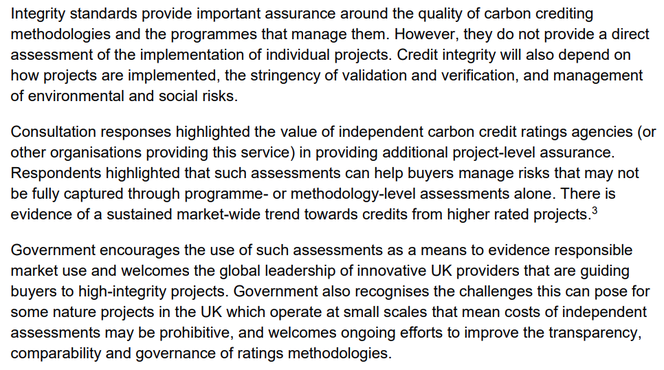
This direction of travel is very positive. It moves away from well-meaning but ambiguous principles (e.g. choose credits that are “generated through the application of conservative baselines”), towards a framework that is inherently more actionable. The government has heeded calls to not reinvent the wheel and create its own integrity standard.
Instead, they have opted to recognise the work of the ICVCM and PACM Supervisory Body in ushering in a new generation of more conservative crediting methodologies. It also acknowledges the significant investment that independent carbon ratings agencies like BeZero Carbon have made in aggregating the capabilities to independently assess risks at the project-level, and the role such assessments can play in reducing project-level due diligence costs.
However, the devil is in the detail of how this "encouragement" is implemented in practice, and here there is more guidance to come:

From a ratings perspective, this incoming guidance should look to offer clarity on questions such as:
How ratings can be used in practice to build a risk-diversified credit portfolio;
How organisations should handle ex post issues emerging within their portfolios (as expressed through ratings downgrades); and
How disclosure of credit use should work in practice, and how ratings can help communicate the integrity of individual credits.
One integrity-related issue that receives little attention in the consultation response is durability. What counts as a “durable removal” will be critical to the long-term role of pathways such as afforestation and biochar within corporate net zero strategies.
Contracted durability solutions such as the Permanence Trust, backed by specialised insurance and informed by advanced project-level risk analytics, offer a promising way to manage the real risk of carbon being released after credits have been issued under non-geological removal pathways.
The UK’s financial services expertise and ecosystem of specialist insurers and ratings agencies put it in a strong position to become a global centre for contracted durability solutions. The UK government can leave organisations such as the SBTi to determine the future role of these pathways, or take a lead in shaping it. We would encourage it to take the latter path.
2. Incentivising voluntary demand
The lack of clarity on where carbon credits can play a role within an organisation’s net zero strategy has been a major demand inhibitor over recent years. The government’s proposed solution here is - in essence - to endorse the view of the SBTi’s Corporate Net Zero Standard 2.0:
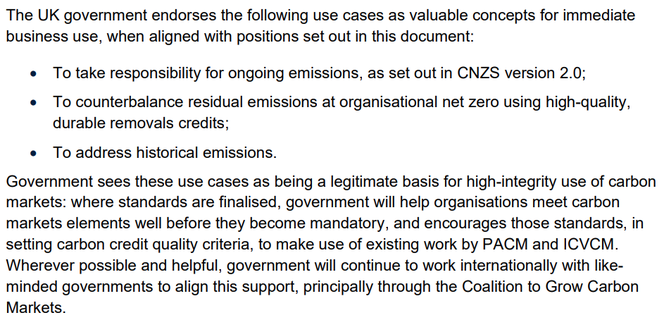
While it is helpful for the government to offer some clarity, the inherent limitations and contradictions in the SBTi approach must be actively mitigated. One of these issues - what counts as a durable removal - was highlighted above.
The SBTi’s approach to taking responsibility for ongoing emissions leaves a significant gap: its requirements do not begin until 2035, while the “recognition tiers” available before then offer little meaningful incentive to act.
The government hints at a way forward through a potential incentive scheme of its own:

However, to truly change the business case for credit procurement, that scheme will need tangible benefits for participating companies, whether through tax incentives or government-backed recognition that can be used in advertising to gain a competitive edge. Securing this will require buy-in from the business department and, particularly for tax measures, HM Treasury. That is unlikely to happen without political backing from ministers at the highest level.
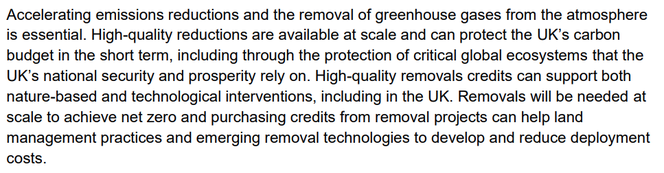
A further issue lies in the SBTi’s approach to emissions reduction/avoidance credits, whose long-term role in ongoing emissions responsibility beyond 2035 is ambiguous. This contrasts with the government’s own unambiguously positive position on the value of such credits, articulated in the consultation response:
In relation to market-based scope 3 action (“insetting”), the consultation response explains the value of such approaches and points towards various ongoing initiatives, but ultimately ends with no meaningful interventions:

A specific issue which the government should be acting to address is the lack of agreed standards and transparency requirements for insetting-based claims. Much thought and attention has been given to these issues in the “offsetting” market, but comparatively little in the “insetting” market. Robust, conservative methodologies and independent project-level risk assessments have an equivalent role to play here, and the government should actively encourage their use to strengthen confidence in insetting claims.
Finally, the government also points to safe harbour measures as a potential way to reduce the legal and reputational risks faced by companies using carbon credits, removing a blocker to voluntary demand:
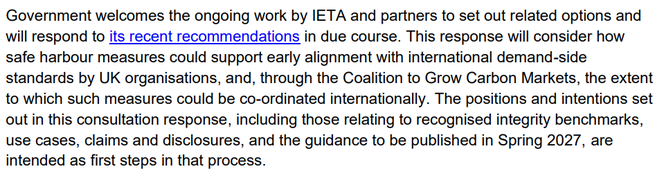
The principle is sound: companies that follow the government’s guidance on credit selection, use and claims should benefit from some legal protection. But the practical questions need careful consideration. What protection does following that guidance already provide, and are additional legal measures really needed to create a meaningful safe harbour? How should protection apply where a company purchases credits that meet recognised methodological standards but carry a low rating because of project-specific risks?
3. Creating demand through regulation and public procurement
Alongside encouraging voluntary purchases, government can create demand for carbon credits through regulation and by acting as a buyer itself. The consultation response addresses both routes, although the commitments are at different stages.
On regulated demand, it points to two existing policy programmes: integrating greenhouse gas removals into the UK ETS and implementing CORSIA’s offsetting requirements. On CORSIA in particular, the response makes reference to the interaction between this programme and the wider high-integrity principles:
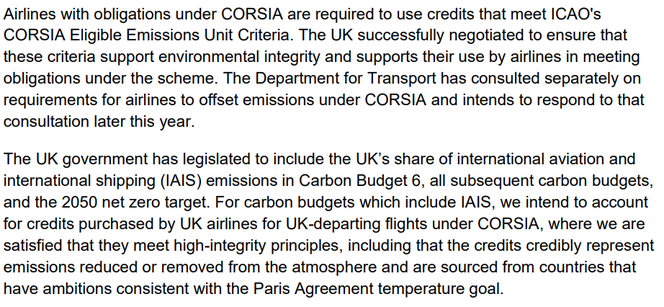
The extract above raises several questions which will require clarification, including:
Will UK airlines be required or encouraged to procure only CORSIA-eligible credits that also meet CCP or PACM standards?
Will the government’s encouragement to use independent project-level assessments, such as ratings, extend to CORSIA purchases?
Will the forthcoming guidance on selecting, using and communicating credit purchases apply to CORSIA as well as voluntary credit procurement?
In relation to government-led demand, the consultation response makes no immediate decisions, pointing only to future consideration of a purchasing fund for Woodland Carbon Code credits:

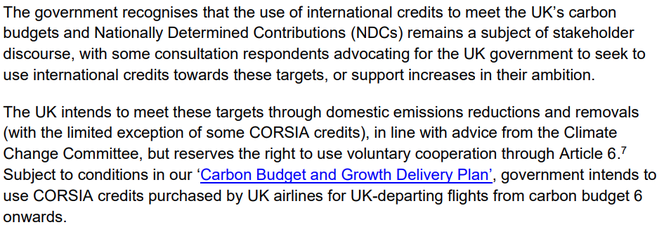
Notably, the UK government continues to support the development of Article 6 markets without committing to purchase international credits towards its own climate targets. This position looks increasingly distinct among its peers. Japan, Singapore and South Korea already have government-backed acquisition programmes, while the EU is developing its own purchasing framework and Canada appears on a pathway to doing so.
4. Creating confidence and unlocking transactions
Beyond defining what high-integrity credits are and clarifying the circumstances under which they should be used, the consultation response also puts forward a series of interventions that can broadly be described as actions to create confidence in the system and reduce barriers to transactions.
Arguably the flagship announcement here is the creation of a new “UK Carbon and Nature Markets Regulator Forum”:
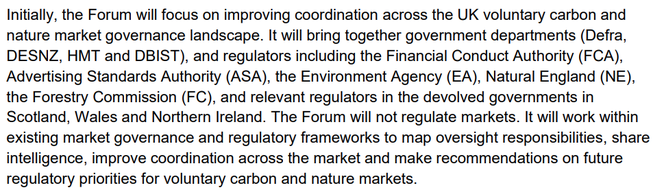
The Forum could be particularly useful in identifying and addressing gaps and inconsistencies in the current regulatory landscape. One example is uncertainty over whether the FCA’s ESG ratings regime applies to carbon ratings agencies. Bringing carbon ratings within a clear, proportionate UK regulatory framework would strengthen transparency and independence, supporting implementation of the government’s integrity principles. Yet agencies and their users still lack certainty over where the regulatory boundary lies. Resolving this issue with the FCA could offer a practical early win for the forum.
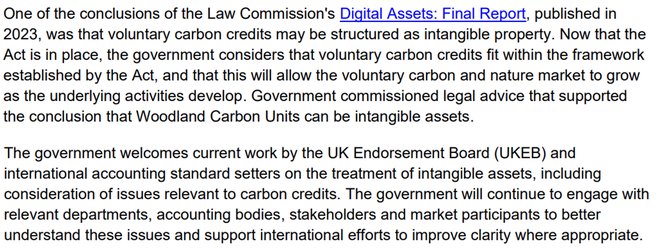
Clarifying the legal and accounting treatment of carbon credits is essential to reducing uncertainty for buyers and investors. On legal treatment, the government explicitly supports the view that voluntary carbon credits can constitute intangible property, while on accounting treatment, the response offers less immediate certainty, acknowledging ongoing work by UK and international standard setters:
An important ongoing intervention referenced in the response is the UK Carbon Credit Auction Pilot, an approach with great potential to lower barriers to entry to the market:
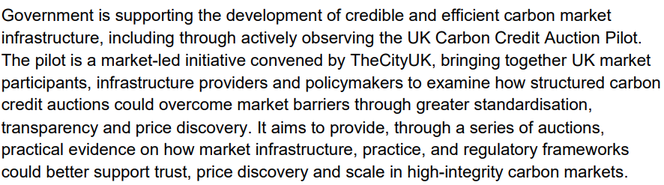
The pilot could act as a sandbox for working through some of the open questions highlighted previously. These include how ratings can support buyer decision-making, portfolio management and risk-based pricing in practice, and how the government’s credit integrity principles can be applied to support CORSIA credit procurement.
Conclusion
The consultation response provides welcome clarity, with further guidance to come. But the government is approaching the limits of what guidance alone can achieve. Moving beyond the VCM’s demand plateau will require stronger incentives and the political commitment to deliver them. Without these, taking responsibility for emissions through carbon markets is likely to remain the exception rather than the rule for most businesses.
The economic case can help build that commitment. BeZero’s paper “From Risk to Reward” contributed to the argument that carbon markets can support jobs, attract investment and build on the UK’s strengths in financial and professional services. Politicians and business leaders need to see credit purchases as an investment with benefits for UK plc: reducing climate-related risks at home and abroad, creating commercial opportunities and strengthening the UK’s influence over a growing global market.