5 things COP31 revealed about the state of carbon markets
Two futures are emerging for carbon credit supply: purism at source or regulated, professional risk management.
Voluntary demand remains elusive, but policy solutions to shift incentives are taking shape.
CORSIA is the most meaningful near-term demand driver, but the paradox of its ‘tonne is a tonne’ model is becoming harder to ignore.
Article 6 credit supply potential is building, though fragmentation of eligibility rules is an issue on the horizon.
Carbon removals and “insetting” advance while fundamental questions of definition and accounting persist.
Sign-up to our webinar on Tuesday 9th December 15.00 GMT / 10.00 EST to explore these themes in more detail with our co-founder Sebastien Cross and a panel of experts.
Introduction
COP31 was billed as the “implementation COP”. Instead, it ended without an overarching agreement, as countries clashed over fossil fuels, carbon capture and climate finance. But beyond the headlines, carbon markets saw quieter progress, both in the negotiations and around the conference hall.
New Article 6 bilateral deals, project authorisations and wider policy announcements point to a market increasingly focused on making the rules work in practice. But they also exposed difficult choices: how to maintain integrity without making projects unviable, create demand that lasts and connect markets with divergent rules.
BeZero’s co-founders were on the ground in Antalya as COP31 unfolded. Their insights inform five major themes that show where carbon markets stand today - and where they could be heading next.
1. Two futures are emerging for carbon credit supply: purism at source or regulated, professional risk management.
PACM discussions across COP31, including in the negotiating room itself, revealed a growing divide over how to turn a set of methodologies into a functioning market.
The final Article 6.4 decision acknowledged concerns about PACM's methodological requirements and asked the Supervisory Body to consider their cumulative impacts when revising them. But it stopped short of mandating a formal assessment of their impact on credit issuance, as proposed in earlier drafts.
On one side of this debate are the purists, seeking blanket conservative assumptions for calculating credit issuance, alongside stringent permanence rules. The objective is to reduce risk to negligible levels across every dimension of the carbon performance of a credit.
On the other are developers who argue that, while admirable in principle, this pursuit of negligible risk makes carbon projects commercially unviable. Their concern is straightforward: a drive for perfection that leaves no projects standing ultimately delivers no climate action.
Assuming there is no return to “VCM 1.0”, two possible futures therefore emerge. In the first, purism prevails, but PACM fails to attract investment because its requirements prove impractical. For developers reliant on buyers that accept only PACM credits, this could leave any projects with a nature-based component (which includes clean cooking) without a route to market.
The second is a future defined by professional risk management. More workable methodologies provide a robust foundation, while specialist tools address residual risks at the project-level. Ratings characterise those risks and track how they evolve. Insurance and professional asset management help mitigate them and take liabilities out of the hands of end-buyers.
This approach has costs, and some existing market participants will resist the additional scrutiny and expense. But it ultimately offers a more agile and financially viable route to scaling supply than attempting to eliminate every risk at source through blunt methodological rules alone.
The purism argument has been characterised by some as the “regulated” future, in opposition to an alternative “deregulated” future. But this framing must be challenged.
First, both futures rest on robust methodological rules: the debate is about how this “regulation” is calibrated, not whether it exists. Second, counterintuitively, the supposedly “deregulated” future is the one in which regulated ratings, regulated insurance and regulated asset managers play a central role.
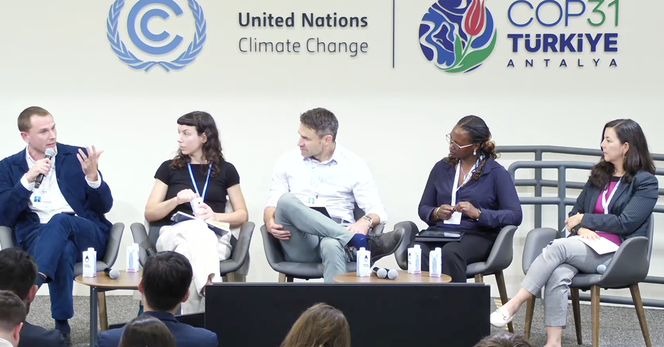
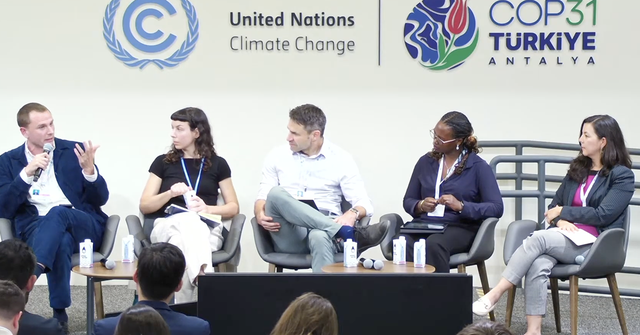
Tommy speaking at a UNFCCC PACM side event
2. Voluntary demand remains elusive, but policy solutions to shift incentives are taking shape.
While views differed on supply, the message on voluntary demand in Antalya was unanimous: “we need more”.
The UNFCCC Executive Secretary’s call for companies to buy PACM credits was no doubt well-intentioned. But demand will remain elusive until policy changes the commercial incentives for buyers. Urging companies to buy more without changing those incentives is like a manager asking their employees to work weekends for a pat on the back.
But COP31 gave us some reasons to hope the circular conversation on demand is starting to shift. The UK Government’s response to its Voluntary Carbon and Nature Markets consultation clarifies expectations on credit integrity and use, with guidance due in spring 2027 and, crucially, the prospect of incentives for organisations that follow it.
Meanwhile, the Coalition to Grow Carbon Markets launched its Policy Playbook. Crucially, its options extend beyond guidance: favourable tax treatment, public procurement rules that reward credit purchases and defined protections for credit-based claims. These are measures that really could give businesses a commercial reason to buy credits.
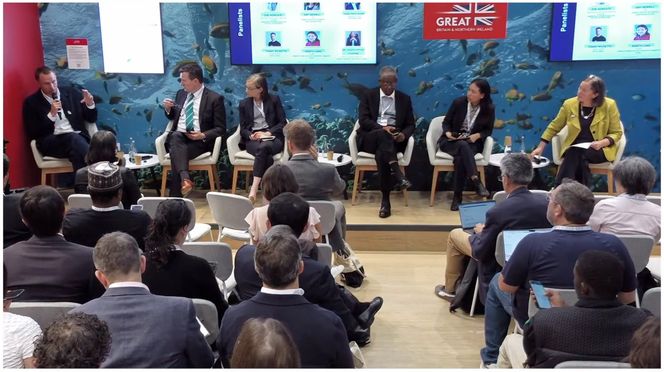
Tommy speaking at the launch of the UK Government’s Voluntary Carbon and Nature Markets consultation response
3. CORSIA is the most meaningful near-term demand driver, but the paradox of its ‘tonne is a tonne’ model is becoming harder to ignore.
CORSIA featured prominently in side-event discussions for a straightforward reason: it offers substantial, near-term demand for authorised credits.
Supply developments around COP added to the momentum, including almost 500,000 credits from a Rwanda cookstove project receiving CORSIA labels for Phase 1 compliance. Meanwhile, the Guyana Jurisdictional REDD+ issuance error offered a reminder that eligibility does not equate to integrity.
2027 is the crunch year for Phase 1: airlines need to retire roughly 200 million credits by January 2028, against around 50 million tagged eligible units to date. That gap puts supply growth under the spotlight. The market will be watching the March ICAO Council meeting for any move to extend the deadline to provide more breathing space.
COP discussions made it clear that attention is already turning to Phase 2. November’s TAB approvals broadened eligible supply for Phase 2 to include Isometric, the World Bank’s FCPF and ISFL programmes and several other standards. PACM received conditional approval for both phases.
This increasingly diverse supply pool exposes a growing tension: every eligible credit carries the same compliance weight, yet the underlying projects have very different risk characteristics and costs per tonne. Put bluntly - what incentive will any airline have to pay more for a PACM credit over a cheaper, non-PACM alternative? Or for a DACCS credit over a cheaper jurisdictional REDD+ credit?
Governments have the tools to address this paradox through their implementation of CORSIA. The UK, for example, could make clear that its integrity guidance applies to CORSIA: use credits from CCP/PACM-aligned methodologies, with ratings guiding project selection and supporting transparent claims. This would not be a silver bullet, but could go some way towards incentivising airlines to pay more for lower risk credits.
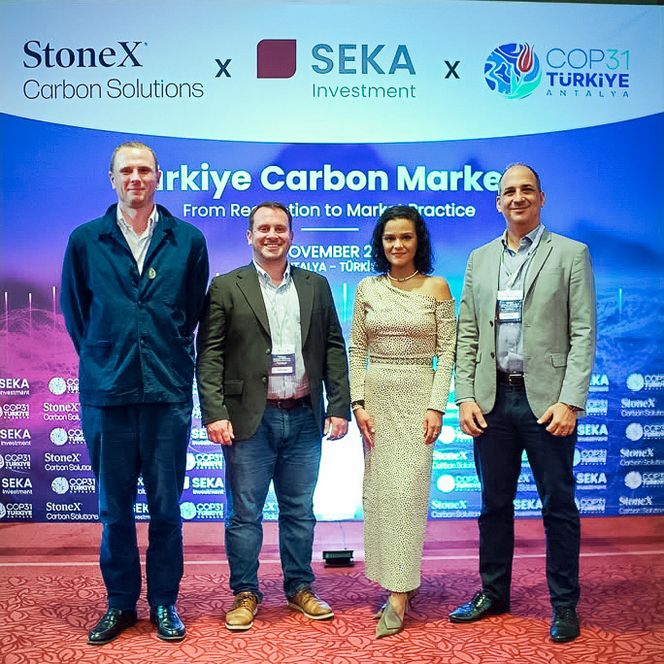
Tommy at StoneX’s CORSIA side event
4. Article 6 credit supply potential is building, though fragmentation of eligibility rules is an issue on the horizon.
Article 6.2 negotiations at COP31 focused on technical reviews, reporting inconsistencies and how to fund the infrastructure underpinning bilateral trading. Countries agreed to some practical improvements but postponed key decisions on funding until 2027.
Outside the negotiating room, activity continued to gather pace. On the demand-side, Singapore announced its first project authorisation and signed a new agreement with Kenya. On the supply-side, in the build up to COP, Brazil approved its Article 6 rules permitting authorisation of up to 50 million ITMOs in 2026–30.
But this positive macro picture obscures a growing concern among developers and investors: sovereign buyers are building complex, divergent eligibility rules and due diligence processes. Developers increasingly have to choose their intended buyer from inception and then design their project around this.
Greater convergence would make projects easier to finance and give buyers access to a wider pool of supply. The building blocks are in place. CCP/PACM methodologies can provide the common foundations. Regulated ratings offer a consistent, independent approach to assessing project-specific risks, reducing duplication in due diligence.
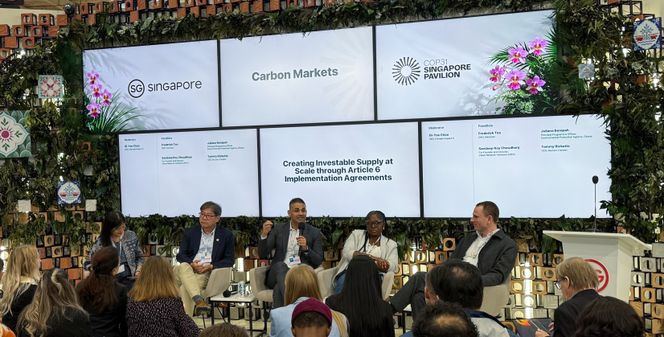
Tommy speaking at the Singapore Pavilion on Article 6
5. Carbon removals and “insetting” advance while fundamental questions of definition and accounting persist.
The new SBTi standard had two clear winners: carbon removals and “insetting”. Discussions across COP31 reinforced that picture, while exposing unresolved questions about how both should be defined, measured and accounted for.
Carbon removals were set to receive explicit recognition in the Antalya Pact, although the agreement was ultimately rejected. Separately, the IPCC is developing new guidance on accounting for removals in national emissions inventories, due in 2027.
But a key question remains for corporate net zero: which removals should companies be able to use to make a credible emissions neutralisation claim?
The answer has major implications for the cost and feasibility of corporate net zero, hinging on how durability, measurement uncertainty and reversal risk are addressed. The SBTi has opened the door to consulting on whether contractual, financial or stewardship mechanisms could give non-geological removals climate-equivalent permanence, allowing them to qualify for neutralisation.
This echoes the PACM debate: should eligibility depend on reducing risks to a negligible level at source, leaving only geological removals in contention? Or can regulated, professional services manage residual risks, allowing a broader range of removals to contribute to neutralisation?
Insetting was not part of the formal agenda, but featured in numerous side events. The attraction is clear: SBTi’s new framework creates more routes for companies to address scope 3 emissions through market-based approaches, while the UK’s consultation response backed credible insetting.
Here too, standards and accounting will determine what scales. Which methodologies should apply? How should technical risks be managed and communicated? What connection to a company’s supply chain is sufficient? And how can multiple buyers support the same supply chain without double counting the benefits?
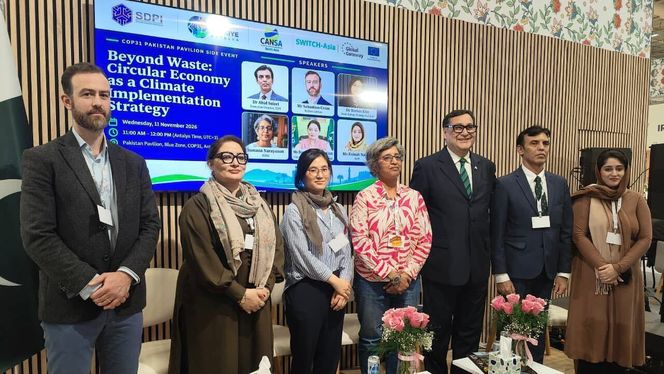
Seb at the Pakistan Pavilion’s Circular Economy event
Conclusion
2027 will bring a series of decisions that shape how carbon markets develop.
In the coming months, the SBTi is expected to present further guidance on the use of credits and other market-based instruments. The UK Government’s corresponding guidance will follow in spring.
March’s ICAO Council meeting will be closely watched for any decision on extending CORSIA’s Phase 1 retirement deadline. Meanwhile in Europe, negotiations over international credit purchasing and removals integration into the ETS will continue.
PACM’s February strategy meeting will set priorities for the year ahead, including further work on methodologies.
Then comes COP32 in Addis Ababa. We expect carbon markets to feature more centrally, given Africa’s climate finance priorities, while PACM’s report on methodological progress could bring fundamental questions about market design back into the negotiating room.