BeZero expands wildfire risk analysis to 1,800 carbon projects in latest State of Wildfires report
BeZero Carbon has led the forest carbon project assessment in the latest State of Wildfires 2025–2026 report, analysing wildfire exposure across nearly 1,800 forestry projects worldwide.
235 projects (13%) experienced fire in 2025, with 2.7 million hectares burned within project boundaries, equivalent to around 4% of their combined area.
Europe saw project-area burning reach nearly five times its historical average, while severe regional wildfires worldwide highlight the growing importance of independent, project-level fire risk assessment.
Bringing carbon market expertise to global wildfire science
BeZero Carbon has contributed to the latest State of Wildfires report, providing a global assessment of wildfire exposure across the voluntary carbon market.
Led by our Director of Remote Sensing, Dr Niels Andela, and Senior Remote Sensing Scientist, Dr Dave van Wees, the research combines BeZero's global project-boundary database with more than two decades of satellite observations to assess wildfire exposure across 1,798 forestry carbon projects, almost doubling the coverage of last year's analysis.
The State of Wildfires Report is an annual publication, bringing together contributions from leading global experts working at the UK Met Office, the European Centre for Medium-Range Weather Forecasts (ECMWF), the University of East Anglia (UEA), and the UK Centre for Ecology & Hydrology (UKCEH), as well as scientists from 20 other countries.
As the State of Wildfires exclusive carbon markets partner and industry sponsor, BeZero is helping advance scientific understanding of how fire affects carbon projects and the permanence of their climate benefits.
Mapping wildfire exposure across the carbon market
The assessment found that 235 forestry carbon projects experienced fire during 2025, representing 13% of those analysed. In total, 2.7 million hectares burned within project boundaries, equivalent to around 4% of the combined project area.
Africa accounted for the largest area burned within forestry carbon project boundaries, at 2.2 million hectares, despite project-area burning remaining below its historical average. Many African forestry projects are located in seasonally dry woodlands, ecosystems naturally adapted to fire.
Europe presented a contrasting picture, with project-area burning reaching nearly five times its historical average. Notably, 92% of the burned area was concentrated in just two projects in Portugal and the UK, where fire affected 79% and 51% of their respective areas.
These findings highlight considerable geographical variation in wildfire exposure and the importance of assessing individual projects in the context of their local ecosystems and fire regimes.
Extreme regional fires despite a quieter global year
The wider report finds that the global burned area was 18% below its historical average during the March 2025–February 2026 fire season, partly due to a long-term decline in savanna fires. However, devastating forest fires in Canada, Northwest Iberia and Chile illustrate how global trends can mask increasingly severe regional extremes.
Climate change made extreme fire weather in Northwest Iberia approximately three times more likely, reinforcing the importance of understanding how wildfire risks are evolving under a warming climate.
Strengthening the assessment of carbon credit quality
Wildfire risk is a key consideration when assessing the permanence of nature-based carbon credits. However, exposure to fire does not necessarily result in carbon loss or a reversal of credited climate benefits. The consequences depend on the severity of the fire, the carbon pools affected, the ecosystem's resilience and capacity to recover, and the effectiveness of project-level mitigation measures.
BeZero incorporates these considerations into its independent carbon ratings, combining historical satellite observations, near-real-time fire monitoring and forward-looking climate analysis to assess physical risks to carbon projects.
Our ongoing research, including recent monitoring of fires across Indonesia's carbon projects, demonstrates how these capabilities can support continuous risk assessment.
Through our scientific contribution and partnership with the State of Wildfires Project, BeZero continues to advance transparent, evidence-led assessment of wildfire risks, helping carbon market participants better understand and manage the risks to carbon credit quality.
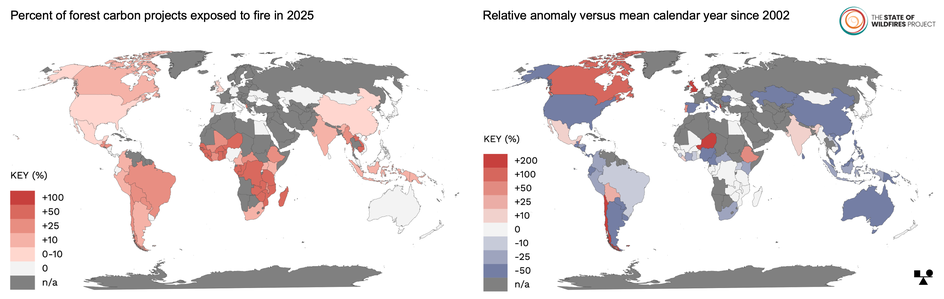
Global wildfire exposure across forestry carbon projects in 2025 (left) and how these compare with historical observations since 2002 (right). Source: State of Wildfires 2025–2026, with analysis by BeZero Carbon. Explore the interactive maps.
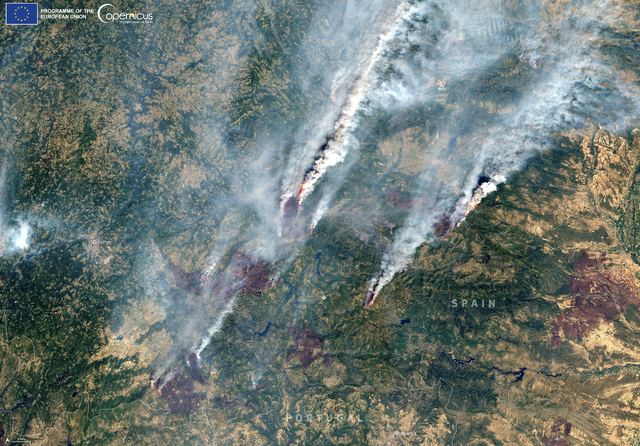
Cover image: European Union, Copernicus Sentinel-2 imagery