Seeing eye to eye: how holistic beyond carbon appraisals enable safer transactions
Here are some key takeaways
A carbon rating and a 'beyond carbon' profile measure different things. A project can have high carbon efficacy but still carry social or environmental risk, or a low likelihood of achieving the co-benefits it claims.
The market needs a shared understanding of non-carbon risks and benefits. Most tools available today measure different things and rarely line up, which can leave parties in a transaction working from asymmetric information.
BeZero’s Beyond Carbon Risk and Benefits Assessments offer a holistic, independent, and quantitative appraisal of both non-carbon risks and benefits.
These impartial metrics help buyers, investors and project developers see eye to eye, supporting reputational protection, de-risked investment decisions, and a fairer basis for pricing credits with demonstrable impact.
Most carbon market actors now know to ask whether a credit truly represents a tonne of CO₂e avoided or removed - this is the main role of carbon ratings.
Fewer have a reliable way to answer the next question. Is the project managing the risks it poses to the people and ecosystems around it, and are the community and environmental benefits it claims actually likely to materialise?
Buyers often know they want safeguards and co-benefits, but the two can get blurred into a single catch-all that mixes up avoiding harm with delivering good, masking each of their respective impacts. The instruments used to judge them, from in-house ESG screens to certification labels, consultant reviews, and broad project scores, each look at the question from a different angle and do not always line up.
The result can be an asymmetry of information, where parties in a transaction work from different pages and rarely speak the same language. Buyers need a simple way to understand exactly what they’re buying, and how a project’s ability to avoid harm and deliver benefits marries up with their individual risk tolerances and priorities.
A strong carbon rating doesn’t tell the whole story
It is tempting to assume a high carbon rating means a project holds up to scrutiny across all dimensions. In practice, carbon and non-carbon impact can either diverge or converge.
Consider a few illustrative profiles. A reforestation project in South America might earn a high BeZero Carbon Rating of ‘A’ yet sit at Tier 4 (moderately high) for beyond carbon risk: strong on carbon efficacy but more exposed on the social and environmental side. A cookstoves project in Africa might hold a more modest ‘BB’ carbon rating while showing a Tier 2 (moderately high) likelihood of beyond carbon benefits alongside Tier 2 (moderately low) non-carbon risk.
The pattern can hold at the extremes too. An ‘A’-rated waste project with a high likelihood of delivering a tonne of CO₂e might still carry high beyond carbon risk, where severe pollution and health impacts drive community opposition and negative media coverage, while offering few benefits in return.
Depending on a project’s specific context, carbon efficacy and beyond carbon profile can either show tradeoffs with one another, or alignment. For example, long-tenured contracts may reduce risk to permanence, but also introduce risk for smallholder farmers by restricting their rights over their land. Conversely, a project that intentionally manages fire risk for seedlings may also reduce communities’ exposure to fire.
As one investor put it, reflecting on a project that had made the news for causing health problems in a nearby community, the underlying logic is straightforward: “If you want someone to invest with the purpose of saving the climate, you cannot also invest in a project that is making people sick.”
Buyers who look at the carbon rating alone see only part of the picture. A separate, comprehensive read on non-carbon risks and benefits gives a more holistic picture.
What this means for buyers, investors and developers
The consequences land squarely on the people sitting at the centre of carbon credit transactions.
Buyers
Corporate buyers carry much of the reputational exposure. Projects that have made headlines for harming communities or overstating their impact have at times dampened demand and drawn their buyers into the criticism. A holistic beyond carbon assessment helps a buyer:
Mitigate reputational risk, with an independent, thorough read on non-carbon risk performed by experts in their field.
Know exactly what they are buying, including a clear view of the risks they’re exposed to, potential tradeoffs against benefits, and alignment with corporate priorities.
Look credible in front of stakeholders, from colleagues to customers to regulators, knowing subject matter experts have done the due diligence.
Spend less time defending a strategy and more time building one, turning a record of careful, defensible buying into a credibly sustainable brand.
Investors
Investors and banks face the same exposure with capital attached, and need signals that confidently hold up in front of an investment committee. A holistic appraisal helps an investor:
Make de-risked investment decisions, through a quantifiable, transparent, and holistic measure of both downside risks and upside benefits from a third party.
Convince buyers with a defensible narrative, turning a wooly co-benefits story into analyst-backed evidence of project impact.
Build a reputation for backing credible, lower-risk projects that deliver on their claims, opening the door to repeat business.
Project developers
Carbon project developers may have the most to gain of all. Where a developer cannot effectively communicate robust safeguards and benefits, it runs the risk of failing to sell credits at a fair price. A holistic appraisal helps a developer:
Demonstrate outcomes instead of box-ticking, with independent, transparent evaluations of both a project’s safeguards and its benefits claims.
Differentiate a high-integrity project in a crowded market, and support a fairer price where risks are low and benefits well evidenced.
Lift the burden of proof, since an expert third party has done the work, which can mean fewer fragmented diligence requests and more time raising capital.
Build a track record as a credible developer with projects forensically reviewed by a third-party ratings agency, potentially opening access to capital and project expansion.
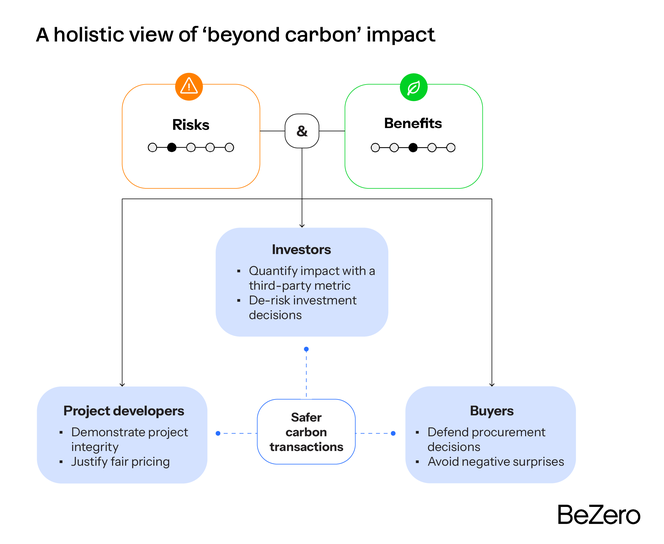
Carbon advisers and marketplaces benefit too. A third-party assessment by BeZero’s expert team can help them curate vetted inventory and stand behind their recommendations to reputation-sensitive buyers.
As one estate owner managing land for carbon put it, better to invite scrutiny rather than avoid it: “If we can invite people to come and look in the dark corners and shine a light on those areas that are of concern, that should hopefully reduce that risk so that an offtaker or a buyer can make the best informed decision.”
Filling a gap
The market is not short of tools for thinking about social and environmental impact. The point is that the most widely adopted approaches were each designed for a particular purpose, and may not answer the full beyond carbon question on their own:
Safeguards are a good start, offering mechanisms a project can put in place to reduce harm, but they don’t guarantee risk mitigation, and effectiveness is highly context-dependent.
UN Sustainable Development Goals (SDGs) provide a valuable shared framework, though they were not originally intended for individual carbon projects.
Certification labels by standard bodies (e.g. Verra’s CCB and SD VISta labels) can confirm that a project was designed against a given framework and provide information about socioeconomic and environmental aspects, even if they may say less about the risks inherent to its context or its eventual outcomes on the ground.
Consultant reviews can go deep, and many buyers rely on them, though bespoke reviews can be harder to compare and scale across a large portfolio.
In-house ESG teams bring valuable internal knowledge, while in some cases lacking the local nuance a specific culture or geography calls for.
Each of these can have a real role to play. What can be harder to find is a consistent, transparent way to bring both sides of the beyond carbon picture together - the harm a project might do and the good it might deliver - in a format that can be compared across projects and read by everyone at the transaction table.
A common view: what a holistic appraisal looks like
This is the gap BeZero’s Beyond Carbon assessments are helping to close. Performed by a team of cross-disciplinary experts, these appraisals sit alongside an ex ante carbon rating and keep two things separate that the market often merges, namely the risks a project poses on the one hand, and the likelihood of the benefits it claims on the other. Assessing them separately matters, because if the two are combined, high benefits can mask high risks, and high risks can obscure real benefits.
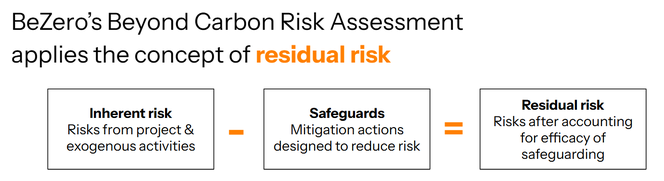
BeZero’s Beyond Carbon Risk Assessment applies the concept of residual risk, the risk that remains once a project’s safeguards are weighed against the risks inherent to its activities and its context. A project in a setting with weak enforcement of labour law, for instance, starts from higher inherent risk and may need stronger safeguards to bring its residual risk down.
The assessment works across three risk factors:
Socioeconomic risk covers land and resource rights, labour and livelihoods, diversity and equity, benefit sharing, stakeholder engagement, and health and education.
Environmental risk covers ecosystems and biodiversity, natural resources and natural hazards, and pollution.
Public sentiment covers stakeholder commentary and media coverage.
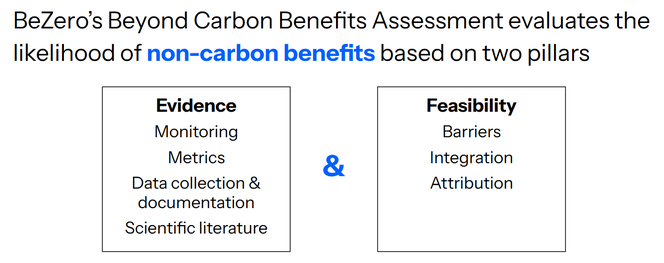
Our Beyond Carbon Benefits Assessment looks at the other side of the ledger, asking how likely a project is to deliver the benefits it claims, together with any material benefits BeZero identifies that the developer has not claimed.
Likelihood rests on two pillars:
Evidence examines the strength underpinning a claim, including the project’s monitoring, its metrics, its data and documentation, and whether scientific literature supports the expected outcome.
Feasibility asks how realistic the benefit is in practice, looking at the barriers to delivery, how well the benefit is integrated into core project activities, and whether it can reasonably be attributed to the project rather than to factors that would have occurred anyway.
The assessment also notes where benefits align with the UN SDGs.
Because it showcases the positive, BeZero’s benefits assessment is always conducted alongside a risk assessment, to avoid any positive bias.
Risks and benefits are expressed separately on a simple, five-point tier scale. Tier 1 is the highest (low risk, high benefits likelihood), and Tier 5 is the lowest (high risk, low likelihood). Every tier traces back to the specific drivers beneath it, and the full methodology for each is published on our website (risk assessments and benefits assessments).
One government entity described BeZero’s expertise in this space as offering “a scientific approach that leads to concrete and practically useful results”.
Seeing eye to eye
Put a transparent, comparable, and independent metric in front of a carbon transaction, and the information asymmetry between carbon credit suppliers and buyers begins to dissolve.
A developer can point to third-party evidence of its safeguards and benefits, rather than asking a buyer to take its word. A buyer or investor can see what they are committing to across both downside risks and upside benefits, in a metric they can point to in an investment committee. An adviser can stand behind a recommendation with more confidence. Crucially, pricing discussions move from a question of who holds which label towards a more evidence-based and outcome-oriented conversation everyone can follow.
That shared footing is what BeZero’s holistic beyond carbon assessment offers. It gives each side increased confidence around a project’s risks and benefits ahead of a purchasing decision. And because BeZero holds no stakes in the projects we assess, there are no vested interests in a deal going through or not.
When the stakes are this high, this shared understanding of holistic project impact is what safer transactions are built on.
If you’d like to discuss the non-carbon risks and benefits of a project you’re developing, investing in, or buying, get in touch.